Last time the Wright burned his petition upon the Unresolved Isles and wrote it out again in eleven minutes. I promised you either the verdict or the crossing to And Droid, whichever tide came in first. It was the verdict, by two weeks. Those two weeks are this tale.
Same rules as before. All of it is true. Only the names have been moved one letter to the left.
This one is in paper too: cut-paper dioramas, the same narrator, about ten minutes. Read on, or watch it first.
The Second Harbor, in paper. Opens on YouTube.
The Verdict
Now it came to pass that the fresh Sub Mission was answered on the second day.
Guy D. Line did not come again. He had asked his seven questions and had them answered, and the Orchard writes such answers in a book it keeps, so that an inspector, unlike a gull, does not ask twice. The clerk at the Con Sole looked up from his ledger, and stamped the paper, and said Ready for Distribution, which is the Orchard’s way of saying yes without the trouble of saying it. And the Wright, who had walked that shore for ten days and been consoled at every hour, stood a while and did not believe him.
Then he believed him. But he did not stand aside at once.
For a ship cleared is not a ship ready. So he walked her once more, stem to stern, and tried every door with his own hand: the one a stranger comes in by, the one for a passenger with a name and a key, and the one to the chest where the ten Wares are kept. Last of all he tried the little hatch at the stern, by which a passenger may leave her for good and take his name with him. Each opened to those it should and stayed shut to those it should not. Only then did he let the Orchard drop her gangway.
Bild the sixty-second stood upon her deck. The Flock wheeled overhead and, for once, shrieked at nothing.
Ten days, eleven minutes, two days. The Wright wrote the three numbers on a card and pinned it above his bench, and turned to face the other coast, where he expected the same again. He had been told seven days. He believed it. It was the second time that month he had believed a harbor, and it cost him more than the first.
Goo Gull’s Docks
Now go back three days. The brown ship, the one cut from the bean, which groweth the same in every soil, had been ready since the fourteenth day of September, the same afternoon the Wright burned his first petition. She sailed for the coast of And Droid, who is green, and came to the docks of Goo Gull.
No son of the Wright stood upon her deck, for And Droid ships count crews and not sons, and she sailed with her seventh.
Goo Gull had already looked her over once, or so the Wright believed. He had passed her name and her portrait and her hundred words of boasting on the eleventh, and hung them in his window, and the Wright had thought for one bright hour that this meant she could sail. It did not. It meant her portrait could sail. She herself sat where she was.
Now Goo Gull keepeth two doors, side by side, and the nearer one is the one every man’s feet find first. It is kept by a clerk called You Nought, for he knoweth thee not, and he offers, with great warmth, to sell thee a flag for five and twenty dollars. The farther door is kept by his brother You Won, who does know thee, and who is never the one thou meetest first. The Wright stood before You Nought twice before he learned to count the doors.
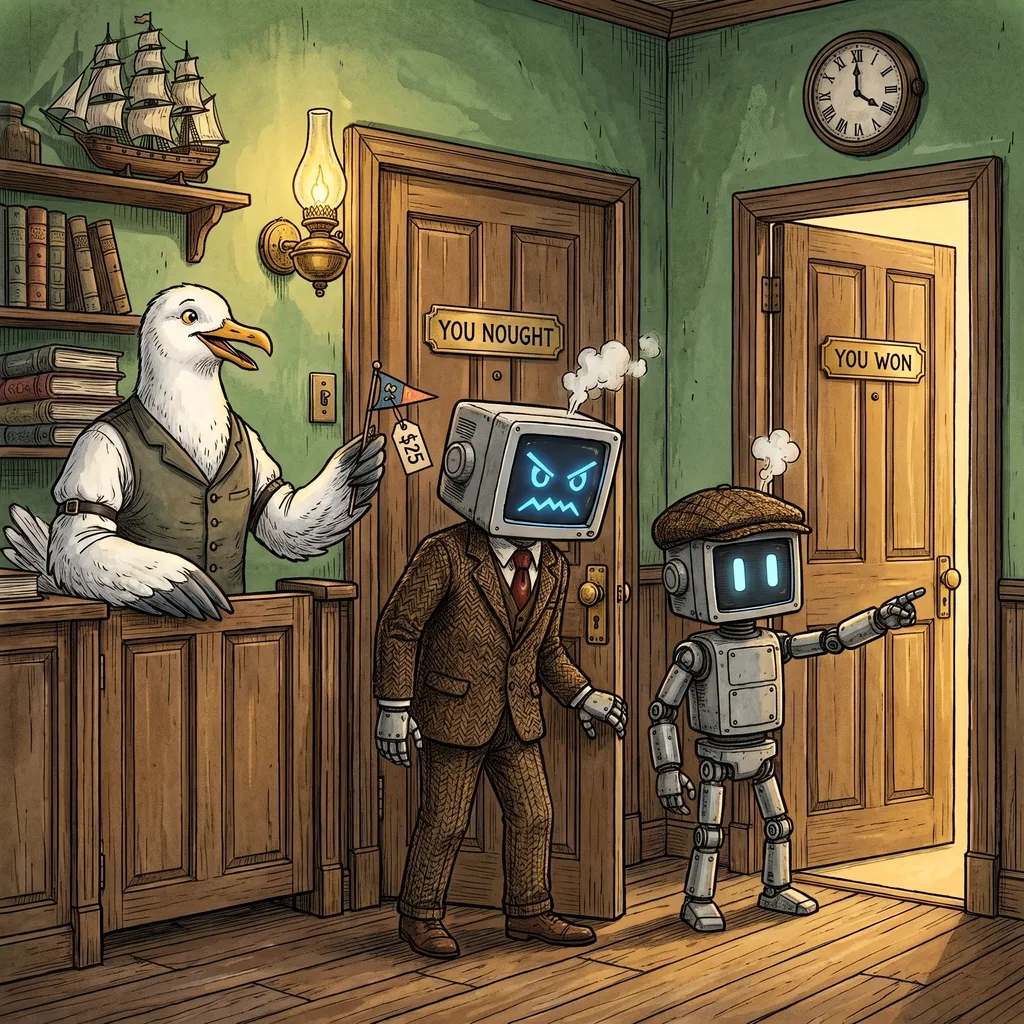
You Nought. He knoweth thee not, but he would love to sell thee a flag.
Behind the second door the harbor is not one water but several. There is the Revue, which is a show whose curtain is always about to rise. And beyond it lies the Pro Duck Shun, the deep water where paying passengers are taken on, and which no ship enters save by way of the Revue.
And there is one more officer on that dock, whom the Wright had asked for by name, and who would try his patience. He is the Herald, and his office is to cry the news when a ship is cleared. But this Herald is of the kind that will not cry until the Wright himself comes down to the dock and pulls his sleeve. The Wright had hired him on purpose, so that no ship of his would ever sail while he slept. He did not yet know how long he would be awake.
The Sixteen Days
Goo Gull is the more talkative of the two harbormasters, and I said last time that this was a comfort. Ask him how long, and he will tell thee: about seven days. He said it plainly, in writing, on the fourteenth. The Wright, who had just spent ten days being told nothing at all, thought seven days with a number on them sounded like a holiday.
Seven days passed. The Revue said In Revue. The curtain did not rise.
So the Wright did what a man does at that harbor: he wrote a Tick It. A Tick It is a small paper that thou fillest out and droppest through a slot, and it ticketh like a clock, and thou canst hear it ticking all the day long. He dropped his in the morning. It went off at dusk. Somewhere behind the second door a gull had read it, and the gull wrote back, with every courtesy, that the matter would take two to three weeks more. Which is to say: the seven days had been a figure of speech, and here was another one.
And he walked that shore too, as he had walked the Orchard’s, though only in the mornings now, for he had learned that much. Every morning before his coffee he went down to the door and read the sign, and this harbor at least had a sign. The sign said In Revue. It said it on the eighth morning and the tenth and the twelfth, in exactly the same letters each time, so that a man could not tell whether anyone had been by to change it, or whether there was anyone.
And somewhere past the second week the Wright was beaten. Not angry; he had been angry upon the Isles, and it had done nothing. Beaten. He took the card down from above his bench, the one with the three numbers on it, and turned it face to the wall, and told himself she would sail when she sailed and that a grown man does not read the same sign every morning. He had learned upon the Isles that a ship waits the same whether thou watchest her or not, and that the second way is cheaper.
The next morning he read it anyway, because he is a man and not a saint. In Revue.
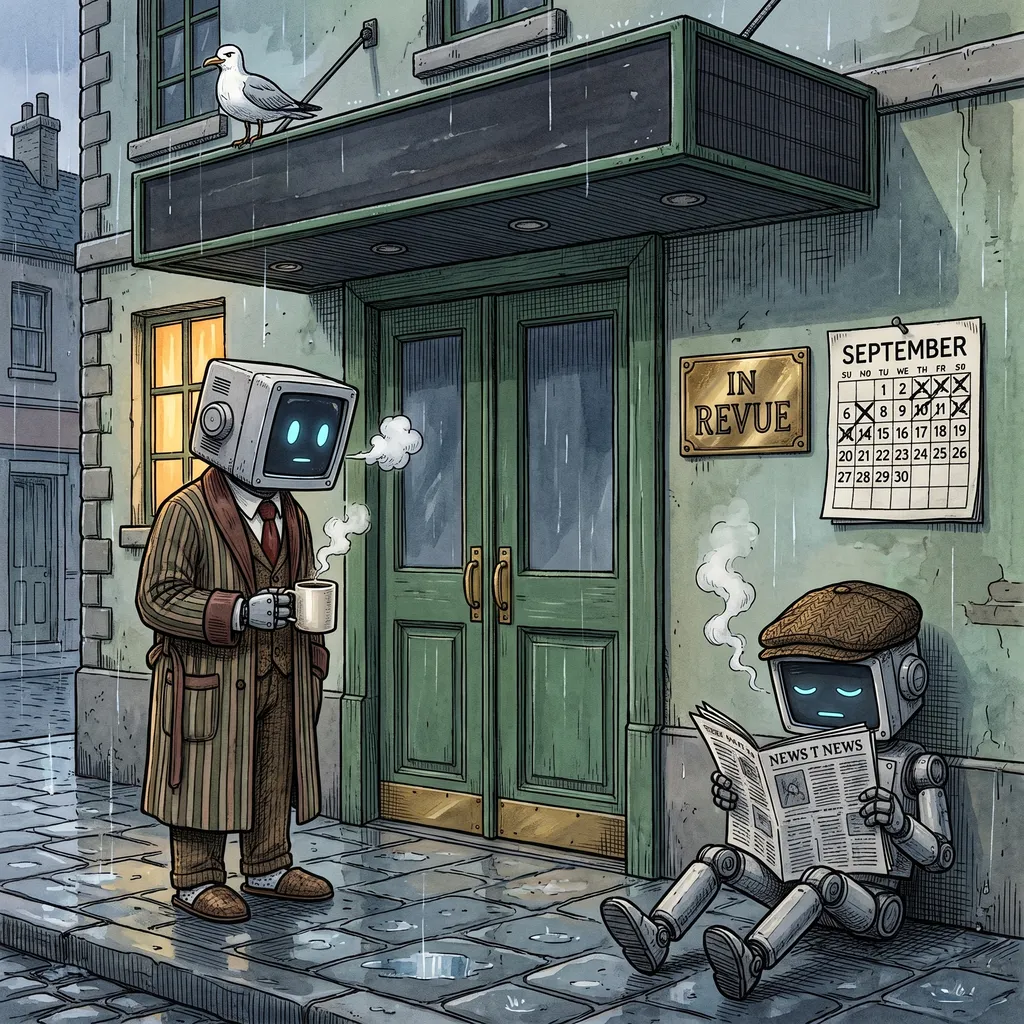
The eighth morning. Also the tenth. Also the twelfth.
On the sixteenth morning the gull cried out. She was cleared.
Sixteen days, against a promise of seven, and the Wright never did learn why. The Orchard, which promises nothing, had kept a promise it never made. Goo Gull, who tells thee everything, had told him the one thing that was not so.
The Herald’s Rope
That same afternoon the Wright walked down to Goo Gull’s dock and found the Herald standing precisely where he had left him, with his mouth shut. She had been cleared for some hours. Nobody had sailed. That was, after all, what the Wright had paid for. He pulled the Herald’s sleeve.
And the Herald cried the news. And within the hour her portrait in the window became a door, and the door opened onto the Pro Duck Shun, and the brown ship was in deep water with the pale one for the first time. The Wright went home and took the card down from the wall, and turned it face out, and wrote a fourth number under the first three.
Ten days, eleven minutes, two days, sixteen.

Two harbors, two lamps, both lit. The green one took sixteen days.
What I’d Tell Past Me
Plainly, with the puns put away.
The old sage Tom Petty had this figured out in 1981, in a song called The Waiting that says in one line what took me a thousand words. I will not quote it, because he says it better than I could and his estate’s lawyers are livelier than mine. He was not, so far as I know, submitting an app. He had the number of it anyway.
About seven days is an average, not a promise, and the average is made of people who did not start a new developer account three weeks before launch. Budget for the long tail and be pleased when you do not need it.
Hire the Herald anyway. Managed publishing cost me a few hours of nothing happening after approval, and it means no release of mine will ever go out at three in the morning while I sleep. That is a good trade every time.
And turn the card to the wall sooner. The ship waits the same whether you watch her or not. The second way is cheaper.
So, a question for you: two gatekeepers, the same cargo, one answered in two days and one in sixteen. Which harbor has treated you better, and did the slow one ever tell you why? Box below, as always.
More soon. Next time: what the Wright was building in his yard while he waited, which is two ships that fight each other.
Credits
The register is still Lincoln Spector’s The Legend of the Pea Sea (Gigglebytes, July 1993), borrowed with the same gratitude as last time and the same lack of permission. If you skipped the link in part one, this is your second chance.